Friday, December 31, 2010

My Father, Federico Efrain Marrero


This is a plaque commemorating the batiment (pavilion) where Clovis Vincent--and his associates and students (including my father) developed the field of neurosurgery in France. The building is situated in what was originally considered The Pitie Hospital (now part of the Pitie-Salpetriere complex).

On this New Year's Eve, I have much to think about. I'm about to embark on a journey that I hope my parents will join me on, every step of the way. I've told parts of this story in other pieces, such as "Panni's and Pepi's Paris." This time around, I roughly followed my father's own resume; annotated by both him and my mother, Ana Raab Marrero.

For there is no way I can tell my father's story without including my mother. Since the mid-1930's, they became an integral part of each other's lives. And on December 31, 1940--70 years ago today--they became man and wife.

It was not an easy union; with, perhaps, a much easier beginning than its end. They accomplished a great deal; both together, and apart. The part I'm most concerned with today, is that they produced...me. May they both be with me now!

Remembering the good times--in Paris and in the early years in Cuba; when I was born (I hope!)--I wish Efrain and Ana a Happy 70th Anniversary!

MY FATHER, FEDERICO EFRAIN MARRERO
BY GEORGINA MARRERO
My father, Federico Efrain Marrero, was marked by joy and grace. A very natural man: friendly; a bit shy. He was intense; immensely focused on his work, whether it was dealing with a patient in his office; or poring over neuropathology slides in a lab. Considering he came from humble circumstances, he was a natural class act.
A farmer’s son—“and proud of it”—he began to work in the tobacco fields when he was five—he must have become quite an expert at rolling those cigars! In his off-hours, I daresay he was already hard at work on his schoolwork, very serious and intense and competitive. He wanted to be number one.
There is a picture of him when he was ten: standing straight and tall; almost blondish in appearance; just a few fellows down from another boy who was also to become a doctor (Juan del Regato). What strikes me most about the picture is how serious he looked!
Fast-forward to when he must have been about seventeen or eighteen: he looked like a Greek god! His wavy hair; his clear complexion: still serious, though, with softness about his lips and eyes that belied his sensitivity.
He finished his bachillerato (the Cuban equivalent of our high school; plus one or two years); and then began his studies—on a fellowship—at the University of Havana. He was doing his premedical; on his way to becoming a doctor. 1931-1933 were precarious political years in Cuba, though: when President Machado closed down the University, a number of young men prepared to go abroad to finish their education. My father was among the group. The fellowship was provided by the Cuban Company of Contractors.
So Efrain arrived in Paris in 1931. By 1935 he had completed all the coursework and clinical training to enable him to be appointed Extern (Resident) of the hospitals and hospices in Paris after a competitive examination.
By this point in time, he knew what fascinated him the most were neurology; neuropathology; and neurosurgery; and he engaged in these studies since 1935.
He served his first appointment in General Surgery under the Service of Dr. Picot between May 5 and October 31, 1936 at the Hopital Saint-Louis.
This ancient—326 years old at the time—hospital with its arches and courtyards—right smack in the middle of the decidedly eclectic 10th arrondissement of Paris—must have impressed the young man immensely! It is reached via the Goncourt Metro station. You walk down the street; and the street perpendicular to it is the Avenue Claude-Vellefaux. You continue to walk down until you reach the cobblestoned pathway lined with trees and, eventually, buildings. The old hospital is to the left: one archway leading to one courtyard, one after the other; all flanked by the hospital wards (batiments).
I personally wonder what he must have felt, when he first beheld the Hopital Saint-Louis. I got to see it the Monday right before I left during my last trip; and was most impressed. The French have meticulously restored it; without losing its original feel (the “new” building is across the cobblestoned path). Of course, there’s a banner draped across the new building proudly proclaiming its (now) 400 years of history!
And then there’s its Musee des Moulages. A Museum of wax casts of all sorts of maladies. The concierge at my hotel informed me that there’s this eccentric curator you have to personally contact—and with whom you have to “interview”—to make sure you want to see the museum for the “right” reasons. From the peek I got at what the museum holds on its web page, I think I could have handled it.
I imagine my father went to the museum on numerous occasions.
This was my favorite of all his hospitals (barring the Pitie-Salpetriere…or, rather, the batiment at which he practiced neurosurgery with Dr. Clovis Vincent several years later). Yes, it was my favorite of his hospitals—what a first impression!
Next—November 1 through December 25, 1936, he spent time at the Laennec Hospital, on the rue de Sevres, in the 7th arrondissement, in the service of Dr. Rist, whose specialty was Chest Diseases. He was a large—but kindly-looking fellow—from the picture I have of his service at the time. If I’m not mistaken, he was famous for being able to place his ear next to a patient’s chest and being able to diagnose his condition. Now that’s truly called being a clinician!
I believe this was the time period during which he met my mother, Ana Raab, for she was also in Dr. Rist’s service at the Laennec at the time. And in the picture—definitely taken in the late fall—you can find both my mother and my father! At first I couldn’t believe it was my papi: but his smile is unmistakable!
My mother continued to do a full year with Dr. Rist; but my father—between December 26, 1936; and April 30, 1937--learned General Medicine under the service of Dr. Troisier. He was still at the Laennec, which is a monster of a complex; was abandoned in 2000; and is now being “converted” into condos! This has all happened since I was there last November. At the time, it appeared like an abandoned ghost, a lost (but dearly valuable) soul. It felt very sad, trying to visualize memories that had been so much more palpable at the Saint-Louis!
And then the first of his three dearest wishes was granted: he became a resident in neurology at the Salpetriere Hospital (or, l’Hospice de la Salpetriere, as it was also known), under Georges Guillain, one of the preeminent neurologists of his time. He served under Guillain between May 1, 1937 and May 8, 1938.
Remember that he’d already been dabbling in the neurosciences since 1935…
Cute story time: at some point—maybe, between 1931 and 1935, he’d been in an ob-gyn rotation. I have a picture from the time period of my father sporting a beard. Well (and this perhaps proves that he met my mother before their time at the Laennec), the equally bearded professor asked a question, directing it at my father. My father could answer…nil. He had no interest in the matter, remember. The doctor then turned to my mother, who instantly answered the question. As a woman, she was fully expected to become either an ob/gyn or a pediatrician. (I believe she was leaning toward the latter.)
And here’s another one: one day my mother stumbled into Vincent’s operating room, stumbling all over the wires! Clovis Vincent—professor of and one of the founders of neurosurgery in France (and my father’s professor)—turned his great head and said, sternly: “What are you doing here, Mademoiselle?” “I’m searching for Monsieur Marrero,” she responded. “Go to the sub-basement. You’ll find him there,” said Vincent before returning to his surgery. Sure enough: Efrain was in the basement…operating on a bedsore!
In her first rotation (at the Hopital Broca), however, she was one of only five (!) female residents in General Surgery. There were plenty more female students in Chest Diseases; and, of course, at the Necker/Hopital des Enfants Malades. For—as I stated before—most female medical students at the time were expected to become either ob/gyns or pediatricians.
In this country you have to pass MCAT’s (and then pray!) to get into medical school. In the Paris of the 1930’s, the ultimate class size was determined by attrition. The competitive examinations my parents endured in 1935 were probably the deciding factor.
Back to Guillen and neurology: the natural progression of things was for my father to further his studies with Clovis Vincent—originally a neurologist, himself, who’d trained with the great Babinsky—in neurosurgery. His externship with Vincent lasted between May 9, 1938; and May 14, 1939. Instead of at the Salpetriere, this time, he worked at a batiment (pavilion) on the grounds of the Pitie Hospital. The truth is, the whole complex is all interconnected.
Clovis Vincent was a great French hero (in—it turned out—both World Wars). He’d led men in the trenches during WWI, for which he’d been decorated. He returned to his medical studies after the Great War; and he and Thierry de Martel founded the field of neurosurgery in France. He came to the United States to learn techniques from the great American neurosurgeon, Harvey Cushing. He tried to save Maurice Ravel in 1937. By then, he’d been granted his professorship in Neurological Surgery; and had his own service. It was during this time that my father must have originally gotten to know him.
During WWII, he craftily turned the service into the “Neurosurgical War Service.” The Germans allowed him to remain in control of it. Many an American and British soldier came to be treated at the Pitie during the War (including many a Jewish soldier). Vincent managed to treat them; and help them get out of France.
He even wanted my father to leave for his own safety: with a middle name like “Efrain,” he might have been suspect. However, my father remained for a second year of residency—as an intern, this time—between 1939 and 1940.
All the while—probably from 1936 on—he became a student of neuropathology: first, under Professor I. Costero of Valladolid, Spain (who’d taken refuge in France during the Spanish Civil War); and then, as a student and assistant to Professor Don Pio del Rio Hortega, who was—to quote my father, here: “internationally known for his investigations in histology and neuropathology.”
Working with Hortega was the greatest treasure and pleasure of his life. Usually obtaining good grades, his best were always in pathology.
It must have been a great pleasure for Costero and Hortega to work with fellow compatriotas; who spoke the same language! Not only as a student; but also as an assistant: Hortega became my father’s mentor. He wrote his thesis under him; he dedicated it to him.
When War broke out, the Chief of the Neuropathology Laboratory, Dr. Berdet, was mobilized. My father—still around, in spite of Vincent’s admonishments—undertook all the work of the laboratory for one year. By this point he had become a second-year intern (by substitution) within Vincent’s Neurosurgical War Service. Ramirez-Corria, who’d been in this position originally, had returned to Cuba (in 1937, I believe).
Vincent’s insistence—tinged with sadness—finally brought my father’s studies in Paris to an end. Efrain presented his thesis in mid-year; and, on July 13, 1940, he was granted the degree of Doctor of Medicine. Almost two years later—on February 20, 1942—he would obtain his Cuban equivalent.
My mother had left Paris by June 13, right before the Occupation. She’d finished her thesis on June 6. She’d moved south to Vichy France, which is where my father caught up with her on (I think) a number of occasions—culminating in helping her get out of a detention camp, I think—some time during late fall of 1940. In the midst of all the turmoil—and what everyone knew the fate of Jews in Hitler’s Europe already was and would continue to be—it was time for my father to return home to Cuba.
In mid-November, 1940, Clovis Vincent wrote Efrain Marrero a letter of recommendation. As best as my translation will allow, here is the last paragraph in Vincent’s letter for my father:
“Only the actual events in Europe have interrupted Doctor Marrero’s stay in my Service. I regret his forced departure because, by his activity, his intelligence, his knowledge and his conscience, he has been for me an excessively precious collaborator. Cuba possesses in him a man of great valor. He will give the greatest service to his Country if one well wishes to confer upon him the post of which he is worthy.”
--Clovis Vincent, Professor of Neurosurgery at the Faculty of Medicine of Paris, Paris, November 12, 1940
I know of Orleans; the hotel at which they were turned away (and which was later bombed that night). I know they connected with Losa, the Cuban consul, in Lyon; and got married at the Mayor’s Office there on December 31, 1940. Then they found their way to Spain (via Portugal?); spent time in Madrid; and eventually landed in Bilbao.
The Marques de Comillas was a merchant marine ship ready to take them to Cuba. At least one other Cuban doctor with a foreign-born wife was to be on that ship (Ceres Campbell’s great-uncle). The problem was that my mother had a check from the Credit Lyonnais with which to pay the passage. No one would accept her check. Toward the end of her life she told me that she ran through the streets of Bilbao, crying, not knowing what to do. A man appeared: a French Jewish man named Lazard. He gave her the money. So my mother was able to join my father on the ship (and—according to her—did nothing but vomit all the way across the ocean!).
And the rest is history. 2163 words

Sunday, November 28, 2010

Mami--Once Anos Despues


Mami, este ano te queiro escribir en espanol.

Te tengo mucho por decir; pero tambien se que tu me has estado escuchando--y aconsejando--del cielo.
Pienso que te estas viendo mucho mas como madre que como psichiatra a estas alturas: despues de todo--al fin del dia--en tu bata blanca--tu regresabas a la casa; y tenias puesta a tu ropa normal. Y natural. La ropa de Anita--a vintage store's dream! (OK.)

Hace un ano estube en Paris. Que frio; que humedad; y que cantidad de lluvia! Por lo menos, cuando fui al Musee Rodin, hubo sol; para que pude ver a Le Penseur; a The Burghers of Calais; y a las obras exquisitas de Camille Claudel en su gloria! Y esa noche vi al abrigo de lutre de Ghermaine--ahijada de Madeleine Vionnet--en esa exhibicion el el Musee des Arts Decoratifs. Me estaba esperando: ese abrigo. Le tome una foto. Volvi al Hopital Broca varias veces: le tome fotos en blanco y negro; y en color. Parece haber sido bastante chiquito, ese primer hospital tuyo. Necker--el Hopital del Enfants Malades--enorme; y bajo construccion. Y el Laennec--donde conociste a Papi--que haran los franceses con ese complejo de edificios abandonados tan enorme? Prime real estate. Al final fui a Saint Antoine: no lo mas "emocionante" de todos (pero despues del Hopital San Louis, donde Papi empezo, no pienso que nunca vere a uno tan impresivo! Y, claro, el Pitie-Salpetriere, donde camine, camine...y hasta le deje una rosa amarilla en frente de la pavillon de Clovis Vincent, donde Papi practico.)
Pero en todo momento estaba "aware" a quien le pertenecia cual: sus cuentos; sus impresiones. Y tu? En los cafes todas las tardes con Kati y sus amigas: cuando estudiabas? Te entro todo via osmosis? Papi estudiaba bien duro; especialmente cuando estaba aprendiendo de Guillen; de Vincent; y--por supuesto--Hortega. Y tus cuentos con Vica: el conde de Esterhazy, eh? Lo pasaste muy bien, en Paris...y, al final, te espero tu Diplome d'Etat; que lo tengo colgado con mucho orgullo en mi pared.

Mami la doctora. Despues, Mami la ama de casa cubana. Despues, madre en en Exilio...y doctora, otra vez. Residente en Psichiatria. Y practicante de tu profesion, en el South Florida State Hospital.

Pero siempre seras mi Mami. Y ahora, tu sabes que te necesito mas que nunca. Hice lo que tube que hacer al fines de octubre--y que Dios me ayude con el turco! No mas medicina, por favor! (Fuiste tu la quien indicaste lo que yo verdaderamente necesitaba.)

Querida Mami--Dra. Marrero--estes a mi lado cuando te necesite en enero, por favor! Que lastima que no puedes estar a mi lado; explicandome todo, paso por paso. Y, tambien, aguantandome a la mano...

Pero si lo haras del cielo, estoy segura de esto! Papi ha llorado mas (porque ese era su caracter, como es el mio); pero a ti se te han soltado las lagrimas, tambien. Uds. saben que no pedi para que nada de esto pase--

Pero, ahora, los dos, Mami y Papi, La Doctora y el Doctor Marrero: a ayudar a su hija, por favor! A estar a mi lado. Me sentire mucho mejor sabiendo que Uds. estaran ahi, conmigo...

SI, los quiero mucho a los dos. Y se que Uds. me querian mucho a mi, tambien.

Once anos. No lo puedo creer! Han pasado muchas cosas buenas--pero algunas malas--durante este tiempo. Algunas, yo las provoque. Pero este ultimo ano...

Ni modo. Fue una alegria; un placer; y un honor haber estado en Paris hace un ano para celebrar a tus dies. En Paris: tu ciudad. Para siempre.

Esten conmigo ahora, por favor! Se que si lo estan haciendo: ya lo han mostrado, varias veces. Tengo miedo; pero tendre mucho menos miedo sabiendo que Uds. estan a mi lado...

Los quiero mucho. Para siempre.

Su hija,
Georgina

Thursday, December 31, 2009

And I Love Them, Redux: Panni's and Pepi's Paris


Entrance to the Hopital Laennec, Saturday, November 28, 2009.

Today is my parents' wedding anniversary. They married at the Mairie de Lyon (Mayor's Office in Lyon) on December 31, 1940.

By my calculations, they met at the Hopital Laennec between November 1 and December 25, 1936. At least, that's when they shared a rotation in Chest Diseases there.

Oh, irony: and I'm just coming out of a chest disease, in the aftermath of my "exploratory" trip to Paris--no regrets, though.

Although I've published "Panni's and Pepi's Paris" on other blogs, it belongs here--on my "retro" blog--as well. For, I love them.

For Ana y Efrain -- Feliz Ano Nuevo!

PANNI’S AND PEPI’S PARIS

BY GEORGINA MARRERO

For me, Paris is synonymous with the two most important persons in my life: my parents. Anna “Panni” Raab met Federico Efrain “Pepi” Marrero in a medical school class at the University of Paris’ Faculty of Medicine sometime in the mid-1930’s. At the time, people “group” dated, or so my mother told me, so I’m not quite sure when they began to formally date. By 1940, though, they knew each other well enough that my father either sent for or went to pick my mother up in the South of France, they traveled via Orleans to Lyon, and married in the mayor’s office there on December 31, 1940.
My parents’ stories about their years in Paris shaped me. Their stories about forty francs being the equivalent of one American dollar; about a paper cone’s full of French fries costing four to five francs (and that was dinner). About students gathering in the Luxembourg Gardens: I have pictures of them doing just so. About Henri Bergson giving lectures that were so packed that the best my mother could hope for was to strain to hear through the open door. About how he presented himself as a Jew before the Nazis when they occupied Paris.
Those were very difficult times. My mother defended her thesis eight days before the Occupation. And then she fled to Vichy France. As for my father: well, with a middle name like Efrain, his professor, Clovis Vincent, wanted to keep a close eye on him. It just so happened Vincent was a great French patriot, decorated during the First World War. So he ingeniously gathered all his residents together to serve at the Pitie Hospital under the auspices of his “Neurosurgical Wartime Service.”

One of the residents, a man named Rabinowitz, escaped at least several times from detention camps, and eventually made his way to Canada.
For the record, when Princess Diana was rushed to the Pitie and Salpetriere Hospitals after her fatal car crash, my mother’s comment was: “That’s the best place to treat head injuries.” No two ways about it: my mother would have known.
My mother’s strength may have ebbed and flowed, but her stories never wavered. After her death, I had the good fortune to speak with one of her best friends, a fashion designer named Kati Cohn, who filled in many gaps. According to Kati, the Hungarians went to France to study, she said, because they were “freer” there. They were not held back… just because they were Jewish.
Young, carefree, (perhaps?) in love – and she never studied, according to Kati. Panni joined Kati and her crowd at the cafes every afternoon. When did she study, we both mused out loud. She graduated, though, producing a thesis on Nietzsche and Psychiatry. And, oh, yes: she once cooked a veal steak on the back of an iron!
As for Pepi, he studied very hard, yet found time to play ball with his fellow Cuban classmates. He also cooked chicken and rice: hard for me to believe, later on. He had to wash his own clothes, and, at one point, had to do with very little money, for someone had stolen his stipend. I guess that’s when those French fries came in handy.
My father’s passion was neuropathology, so he hit pay dirt when a very eminent Spaniard fled to Paris during the Spanish Civil War. This man, Don Pio del Rio Hortega, guided my father’s thesis. My father dedicated it to him.
Did they have fun? They all had fun, according to Kati.

In the midst of all the storm clouds brewing, yes, they did.
They were young, carefree, and – perhaps – falling in love.
If the following is not an example of young love, then I don’t know what is: According to my mother, she once stumbled into Vincent’s operating room, tripping over wires, and whatnot. The Great Man – a big, hulking French peasant – turned, glowered, and asked Panni: “Mademoiselle, what are you doing here?”
“I’m searching for Monsieur Marrero,” my mother responded. She proudly continued, “He’s supposed to be operating.”
Monsieur Vincent tersely replied, “Go to the sub-basement. You’ll find Monsieur Marrero there.” Sure enough, my father was operating… on bedsores.
As a teenager, I went to Paris, where I spent time with my mother’s cousin and his wife, who’d been made to wear the Star of David during the Occupation. Their daughter’s married to a devout Roman Catholic.
A little later on that summer, my mother came to join me. I’d wanted to go running off to Scotland to do who knows what after finishing my language course in Tours. In a panic, my father had sent her over.
Still highly energetic, my mother marched me up and down the streets of Paris, pointing out this, that, everything. She took me to the oldest restaurant (Le Procope), and the cheapest (Le Bouillon Chartier), where a waiter taught me how to eat an artichoke.
A rebellious child of the times, all I did was fuss, fret, protest, and complain… all the way to the Folies Bergere. Even then, however, I sensed the enormous bond my mother had with her lifelong best friend and her Cuban husband, a bon vivant who’d married the peppy little Frenchwoman, never again giving a second thought to the medical career that had brought him to Paris in the first place, as it had my father.
After she passed away, I braved a cold, damp Paris holiday season to visit with our relatives. I also spent many wonderful hours with her best friend’s now widowed husband. He’d known Efrain for even more years than he’d known Anita. I returned once more, four months before 9/11, when I got to see him for the last time.
I’m bound to return to Paris, and to enjoy The City of Lights more and more in my own right. However, for me, this beautiful, carefree, romantic city will always be… Panni’s and Pepi’s Paris.

Copyright, 2005 by Georgina Marrero 992 words First-time worldwide serial rights

Sunday, November 2, 2008

Destination Stops

Forty-eight years later, still--or, should I say, back?--on the yellow brick road...(took me a few days to digest my Halloween candy this year):


I posted the following for a while; then I took it off. I don't know why...But here it is, back, today, because Halloween has been an important part of my life during the forty-six years that I've lived in this country. It was my first holiday here, which I celebrated within forty-eight hours of our arrival. And then I saw The Wizard of Oz; that first time, on someone's black and white TV in someone's apartment or house in El Exilio, or at the Sevilla Hotel--who knows? All I know is that, on this day full of magic, mystery--and illusion--all that you're about to read is...true. Happy Halloween! Coral Gables, Florida

DESTINATION STOPS: FROM OZ TO THE FIVE POINTS, AND BEYOND

BY GEORGINA MARRERO

Halloween has been my favorite holiday for the past forty-four years. On the second day of my arrival in the United States, my mother put a mask on my six-year-old face, handed me a paper sack, and sent me out trick or treating with the children of other recently arrived Cuban exiles. Returning back to the Sevilla Hotel in Coral Gables that evening, I’m sure I gorged myself silly, totally oblivious to the true meaning behind the witches and ghosts my companions and I had just impersonated.
Without realizing it, I had just participated in one of the typical American child’s rites of passage. In 1960, another event also served to mark the holiday: the viewing of The Wizard of Oz. So it came to be that I entered the Land of Oz for the very first time, in its black-and-white splendor.
Year after year, I returned. I may not have understood a word of the movie that first time, but Judy Garland’s mellifluous voice, the roar of the tornado, the Munchkins’ falsettos, Glinda’s soothing tones, and The Wicked Witch of the West’s cackle were not lost on me. For years I was terrified at the mere thought of her.
By the mid-sixties, I watched Oz for the first time in living color. My command of English was finally good enough to grasp the meaning behind The Scarecrow’s innate intelligence, The Tin Man’s heartfelt wishes, The Cowardly Lion’s brusque—yet gentle—valor, and The Wizard’s good intentions masked behind his ingenuous deceit. Appearances can, indeed, be deceiving.
Dorothy Gale remained my heroine. Brave, intrepid, fiercely optimistic in the face of opposition and insurmountable obstacles, there were times, however, that she almost succumbed. And that was when her friends stepped in. And she, in turn, helped them. I knew my geography by then: Kansas must be an interesting place.
The late sixties found our family in central Georgia. For the first time since our arrival in the States, I had what I would term true American neighbors. A family with four children lived in a big rambling house next door. It was a noisy household, full of fun and laughter. I was always visiting them, being invited to participate in some game or the other. A quiet, but caring, music teacher lived on the other side of our duplex. As a sizeable Cuban community surrounded us, I still remember that I regarded my American friends as “exotic.”
My father had made a very good American friend during our initial years in Miami. This man had lent us money so that we could have a better standard of living during some very lean times. They became colleagues, and then remained friends, for the rest of my father’s life.
My mother kept telling me how we used to visit this man’s home, how we all used to clasp hands around the table and say grace before a meal, and how everyone both admired and feared his formidable mother. Even I remember his mother. Of sturdy Tennessee stock, she had done a good job with her pipe smoking, bowtie clad, vintage Rolls-Royce loving son.
Summers in the sixties found me at a camp for girls in the North Georgia Mountains. To my knowledge, I was the only Cuban there. I learned all about crafts, camping, and camaraderie around a campfire. I even learned to square dance. Sneaking out to meet young men from the nearby boys’ camp may not have been part of my game plan, but I understood that it was a long-standing tradition.
Back in Florida, I finished my high school education at a school established in the 1930’s for the children of winter residents in South Florida: a school built from the ground up. Its founder’s prairie upbringing had borne a good fruit.
College. Even if circumstances had not brought us to the States, chances are I would have found my way to New York. And—as fate would have it—I met someone with a profound interest in American history who was in the midst of turning his avocation into his vocation.
Even his college dormitory room was painted in the colors of the American flag. A nineteenth-century specialist, he had a consuming interest in New York City, including its architecture. I began to learn all I could ever possibly hope to learn about the different types of cast iron buildings, about dumbbell tenements, about the spread of diseases in lower Manhattan during the middle of the nineteenth century, and about Tammany politics.
This bold, enterprising New Yorker had even begun to organize bus tours of New York alongside his professor. He etched and engraved facades of buildings for his Studio class. Not uncommonly, he used to give me private tours of the Five Points and beyond after dim sum lunches with his family.
We hung out for a number of years. His undergraduate research eventually led to his doctoral dissertation. Returning to the City a number of years later, we explored the bowels of the Bowery Savings Bank, and perused the 1855 Census. It was a special treat for this Cuban to not have to worry about getting lost, because an American knew his way around.
Eventually, though, I was on my own. Working—and living—in between two languages and two cultures at different points in my life, I found myself back in Florida. Traveling abroad alone for the first time since my teenaged years, my interests led me to explore the concentric circles of friends and colleagues that surrounded one of the most famous students of American character. Margaret Mead.
Brave, intrepid, fiercely optimistic in the face of opposition and insurmountable obstacles. Wait. I said these words about someone else. Dorothy Gale. Not usurped, but, perhaps, supplanted, now, by Margaret Mead.
Her boldness, her enterprising nature, her strength of spirit was—is—shared by so many, I found out. From Auntie Em, to Dorothy, to D-Day veterans, to the families of 9/11 victims.
Her optimism. Brought home, so recently, by President Reagan’s passing.
Her courage. Brought home, back in 1960, by the uprooting of a family, in a father's and mother’s desire for freedom for their child.
The Wicked Witch’s cackle may still send shudders up and down my spine, but Glinda draws me toward the light.

Copyright, 2004 by Georgina Marrero All Rights Reserved (Now from Washington, D.C.)

Monday, September 1, 2008

Dinner at Arnaud's

We're not out of the woods yet, but it appears as if Gustav will not have been as damaging--at least to New Orleans--as Katrina was. Thank heavens so many people evacuated!

Here's a little something from my La Loquita del Zig-Zag blog that qualifies as "retro":

Sunday, September 04, 2005

Dinner At Arnaud's


A week ago tonight, I found myself in the midst of a power outage due to Hurricane Katrina. I'd lost my power on Thursday, August 25, just as Maria (Julie Andrews) was getting ready to sing "My Favorite Things" to the Von Trapp children. They were trickling into her bedroom, a few at a time, due to a fearsome storm outside. It's an interesting coincidence that I chose to while away my time with "The Sound of Music," isn't it? It's what had struck me I should do when I'd lost my cable several hours earlier, but not my power. Not quite yet, anyway.
I lived through my first hurricane that night. The eye went over my neighborhood. I wasn't quite sure what was happening. Something told me to look outside; I beheld a huge palm frond gracefully draped over my car. Rushing outside, I was relieved the windshield hadn't broken.
I looked some more. Behind my car, black olive branches--some of them huge--had been snapped off the trees, and were lying, helter-skelter, all over the place. The street was flooded. My across the street neighbors saw me; they called out to me. They invited me to come over, offered me dry clothes, food, and, most importantly, companionship. I shall be forever grateful to them. The next morning, I saw what Katrina had wrought: not only were branches down, but whole trees. What is a hurricane, after all, if not a huge, water-filled tornado?
My neighbors banded together like a family. My golf-course designer one house over pulled that palm frond off my car, as well as the black olive branch off my driveway, as if they were mere sticks. I didn't even have to ask.
Friday was assessment day. Shock, I called it. Then came the cleaning; the realization--the resignation--that we might have to be without power for awhile. We didn't know when FPL would get to us, as we were in one of the most devastated areas of the storm.
I learned to tolerate cold showers. I spent my days at my friend's store, where I kept recharging my computer's battery. Friday became Saturday; Saturday, Sunday. By then we knew Katrina was headed toward New Orleans.
I didn't really get to witness what happened on Monday until Tuesday night, when, miracle of miracles, we got our power back on my side of the street (though it had to be turned off for awhile on Wednesday so both sides could be accommodated - THANKS AGAIN to the wonderful crew from South Carolina!). However, I read the paper, saw the pictures...and cringed, and wept--both inside and out--for the beautiful city of New Orleans, for the total devastation that Katrina has wreaked, is wreaking, and will continue to wreak, on the Gulf Coast.
When I was a child, my father and I took a road trip to Galveston. I was nine years old at the time. What follows is the story that came out of me. What would I do without my mother's old pictures? I don't know. I honestly don't know.
I grieve for you, Arnaud's. For your Glass Bottom Everything.

GLASS BOTTOM EVERYTHING
BY GEORGINA MARRERO
In December of 1963, my father and I went on a road trip to visit some friends of his in Galveston, Texas.
For reasons I don’t know, my mother didn’t go with us. Perhaps she wanted a break from her increasingly difficult pre-teen daughter?
No. I don’t think that was it. It probably had more to do with the fact that we still didn’t have much money. Papi was about to finish his residency at the Jackson, and was trying to decide where he’d go, next. For whatever reasons, Miami seemed to be a dead end, at least for the time being.
He had old friends in Galveston. We were probably on our way to scout out the place.
As it was Christmas vacation, Papi and Mami decided I’d go with him. That’s it!
Although we’d been in the United States for only a little over three years at the time, I knew everything about The American Way. There was only one acceptable motel where we could stay: the Holiday Inn.
I drove my poor Papi nuts about staying at Holiday Inns that trip. He obliged me whenever he could.
We headed toward Central Florida first. Then we cut across the state, hit The Gulf of Mexico, and followed the coastline all the way to Galveston.
I was already a voracious reader, and had begun to collect those hard cardboard, glossy-covered Whitman “young lady” adventure storybooks: Annette Funicello on a ranch; and Donna Parker everywhere. Donna Parker in Hollywood had a pink cover, with Donna wearing a sarong and lei at a luau. Later on I’d discover Trixie Belden.
However, I never bought the Nancy Drew books. They were too expensive.
So I probably didn’t drive Papi nuts every second.
The Ocala area was our first stop. As it was my Christmas vacation, we had to have some fun, right?
Papi took me to Silver Springs, to ride on one of their famous glass-bottom boats. We had our souvenir picture taken, along with the other passengers on our boat.
My packrat of a mother kept the picture. Here’s what I see on Boat 27:
Front and left, you find…me. Already on the chubby side, I’m wearing a light colored sweater, a white shirt underneath, and diamond-checked green and who knows what pants. They were probably corduroy. I’m bottomed out with white socks and the Mary Janes that have continued to follow me throughout my life.
It’s the glasses that get me: I’m sporting a dark frame. They’re more rectangular than the pair I know I’d worn just a few months earlier. Definitely less pointy, they’re almost…modern.
I have my hands plastered, one on top of the other, to the side of my right thigh.
Next to me, Papi’s smiling behind his signature green-tinted half-moons. I think his corduroy shirt was blue.
A couple next to him looks almost Eastern European. The woman’s wearing a head scarf. She’s holding a cigarette in her right hand.
On the right hand side, an extremely attractive couple: a blond with a chignon; and a dead ringer for Kirk Douglas, are both smiling, a little enigmatically, at the camera.
Across from Papi and me is an older couple. The kindly-looking woman is looking at…me!
In between us is the glass bottom of a boat.
I may not remember what I saw, but I do remember wondering what it would be like if the glass bottom broke, and we fell through into the water and who knows what.
We made it to The Gulf Coast next: the West Coast of Florida; Alabama; Mississippi; Louisiana.
We spent at least one night in New Orleans, for I remember we went to Arnaud’s.
Antoine’s vs. Arnaud’s: what a dilemma. It had to be a fancy French meal, and it probably stretched our budget, but Papi made sure I ate in a grand French Quarter restaurant. After all, he’d spent many years in France, and probably wanted me to experience a little piece of his—of Mami’s and his—past.
Antoine’s was a little better known. Alas, they were full, so it was Arnaud’s.
I don’t remember what I ate. Maybe escargots, steak au poivre, and some wonderfully delicious dessert? “Sinfully rich” was not part of my vocabulary, not quite yet.
We continued on to Texas. I remember liking Galveston. Papi was glad to see his friends.
Then we drove back. I continued to eat, to read, and to insist on Holiday Inns.
Did I write a “What I Did Over Christmas Vacation” theme for Mrs. Echevarria? I don’t remember. The country was still reeling from the Kennedy assassination. The Beatles were on their way. We were living in the apartment on 14th Terrace by then.
Eight months later we moved to Georgia. The three of us made the trek down from Milledgeville to Miami at least twice a year over the next four years or so. We usually stopped in Ocala.
Not at Holiday Inns, though. Not all the time, anyway.
We never returned to Silver Springs. And I never traveled alone with my Papi, ever again.
Perhaps now I’d become his increasingly difficult pre-teen daughter?
Maybe.
No. Not really.

On August 25, 2005, Hurricane Katrina went over my house as a Category 1 storm. I didn’t even realize it was the eye. My Good Samaritan neighbors, Heather and Tom Jacobsen, and I kept joking to each over, “Boy, if this is a band from a 1, what must the real 1 be like?”
The morning of August 29, 2005, Category 4-5 Katrina swept in, all but destroying New Orleans.
The glass bottom broke for them. Their Glass Bottom Everything.
I sure wish it had been Katrina’s Glass Bottom Everything, instead.
Copyright, 2005 by Georgina Marrero 952 words First-time worldwide serial rights

Wednesday, July 16, 2008

And I Love Them

July 16, summer of 1963: where was I? Oh, yes...

And I Love Them (originally posted on La Loquita del Zig-Zag blog, Wednesday, August 30, 2006):

Light rain is peppering the windowpanes: we collectively managed to dodge Ernesto's bullet. Imagine--just imagine--how things would have turned out if someone else had managed to dodge an assassin's bullets on November 22, 1963.

In a nostalgic mood--and nursing a bad cold--I present you with

AND I LOVE THEM

BY GEORGINA MARRERO

Certain things of note in my life sandwiched themselves between the summers of 1963 and 1964. Two of them affected the entire nation… if not the world. Even I – as an eight to nine year old – realized that nothing was ever going to be the same, again.
In July of 1963, we, as Cuban refugiados (or exilados, as we like to refer to life in the U.S. as living in El Exilio) began to aspire to The American Dream. Papi was a third year resident in neurosurgery at Jackson Memorial Hospital. To paraphrase my mother: “His salary – at $219 per month, as well as his age – at 53, were record-setting. He was the oldest resident in JMH’s history.” Given his knowledgeable background, extensive training, and years of experience, he had been appointed Chief Resident.
My sweet natured, shy – yet gregarious, at times – father had befriended many of the staff at the Jackson. A tall, lanky, bow tie clad, pipe-smoking Tennessean had become his special friend. He called my father, “Fred.”
Basil Yates, who figured in our lives for many years to come, came to our financial rescue. Estábamos muy apretados: we didn’t have much money. As my mother used to tell the story: one day, Basil asked Papi how much money he made per month. Papi replied, “two hundred nineteen dollars.” Was it enough to support a family, Basil then asked him. My father, in all honesty, replied, no. Whereupon, Basil reached into his wallet, pulled out two hundred dollars, and handed the money to my – I’m sure –astonished father. He told Fred he’d continue to do this until his friend finished his residency… to which Papi responded, “I’ll pay you back.” Both men kept their ends of the bargain.
So we were able to move from the kindly, shabby tenement, El Vanta Koor (Vanta Court; now Shenandoah Square), to a better apartment building several blocks away. We were still in La Sauguasera, el barrio close to Calle Ocho that was – and continues to be – inhabited by recently arrived immigrants and refugees. Mami and I could still walk to Calle Ocho. Most importantly, I could still walk to Shenandoah Elementary School, where I would begin fourth grade in the fall.


The Amsterdam Palace

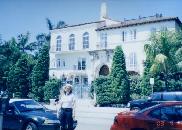
Armed with Basil Yates’ generosity, we were able to spend a month at DA BEECH – as Miami Beach’s yearlong residents lovingly refer to their special place in the sun – that July. We rented an apartment in the Amsterdam Palace Hotel (now the Casa Casuarina). We had the middle oceanfront apartment on the second floor.
There was no air-conditioning… but that’s the way Mami wanted it. Las brisas del mar – the ocean breezes – provided plenty of cross-ventilation. Poor Papi was on call thirty-six out of every forty-eight hours, but, at least, he got to sleep in the alcove directly facing the window overlooking the front of the hotel. He rightfully had the best room in the house!
For my part, I played among the statues and fountains on the first floor, ceaselessly rode up and down the elevator, and spent as much time in the ocean as I could. Sometimes I went swimming twice a day. Mami liked to take me in the early mornings, when the sandbanks were built up, and we were able to walk out into the ocean as far as we dared. Also, we were less likely to become sunburned. Oh, really?
My certain thing of note number one was this: I became very tanned that summer. And I remember getting a really bad sunburn: it hurt, and then I peeled for what seemed like forever. However, I kept going back into the water, playing like a porpoise without a care in the world. After all, I was eight going on nine.
DA BEECH held other wonders: The old, decrepit Art Deco hotels; The old folks rocking themselves on the porches of these hotels; The old cafeterias on Washington Avenue, where a little money bought a lot of food; The fifty-cent theaters, often serving up double portions of old – but wonderful – movies. And then there was Wolfie’s.
Already a bit on the chubby side, I could always find room for more. Wolfie’s was a treat: from Tenth Street, we had to trudge up Collins Avenue to Lincoln Road, so I already had an appetite ready and waiting by the time we got there. I remember the pickles, the cole slaw, the rolls, the stuffed cabbage… and the cheesecake. Oh, that cheesecake…
Sunburn. Yes. There’s a picture of me at a party, sitting next to Papi, where I’m muy bronceada y rosada, all at the same time. Very bronzed and rosy, indeed, after all that Nivea, all that peeling: I’m wearing a white shift with big roses on it. For some reason, I’m shyly looking down at my hands. Papi is glancing over at me. And – yes – for some reason, this is the way I remember myself from the summer of 1963.
Late summer found us in the new apartment. For three years, I had all but stumbled out of bed to get to school, as El Vanta Koor is located next to Shenandoah Elementary School. Now I walked to school, either with Mami, or with some of our new neighbors’ children, who had become my new friends.
As my English had improved tremendously, I fully expected to find myself in an English speaking fourth grade classroom. Full of both eagerness and dread, I entered the fully mainstreamed classroom. To my horror, I found myself being directed back to my third grade bilingual classroom! Was I being held back?
It turned out a number of us were in the same predicament. All of us were cubanitos. We had all done well enough in third grade… but, perhaps, not well enough? Our old/new teacher instructed us to sit down at a separate table, and that is where we remained all year. We weren’t being held back: we were being both linguistically and culturally enriched. Shenandoah – along with Coral Way Elementary – had one of the pioneering bilingual, bicultural programs in the nation.
Our teacher was Puerto Rican. She offered us bilingual instruction, but only when – and if – she had to. I had been her third-grade classroom spelling champion the year before, having achieved the honor with the word, “handkerchief.” Slowly, but steadily, my grades had improved over the course of my first three years. No F’s since the six I had received in first grade, when I had spoken absolutely no English. However, I kept receiving my fair share of D’s… in Physical Education.


It was around that table that Mrs. Echevarria’s “transitional” fourth graders experienced certain thing of note number two: on Friday, November 22, 1963, at just after two p.m., our principal, Miss Hatfield, made an announcement over the loudspeaker. President Kennedy had been shot and killed. We were instructed to stand up, observe a moment of silence, and then we sang “God Bless America.”
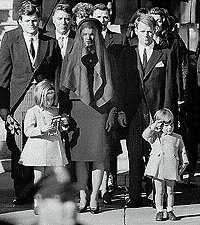
Were we allowed to go home early? I’m not sure. What I do remember is that I – along with my mother and some neighbors – watched the world, as we knew it, change in front of our eyes over the course of the next four days. I remember watching Walter Cronkite – “Uncle Walter,” as I call him to this day – choke up in front of national TV. I have a fleeting memory of the shot fired by Jack Ruby that killed Lee Harvey Oswald. I remember the grimness on LBJ’s face as he took the Oath of Office, with Lady Bird and Jackie flanking him on either side. I remember Jackie draped in black. I remember the solemn procession of the horses at the funeral. And I remember John-John saluting his father.
What I didn’t know at age nine was that several cubanos were considered to be accomplices in the assassination plot. Playa Girón – The Bay of Pigs invasion – had been mapped out at El Vanta Koor. This I knew, even as a child.
Of course, we know by now that we may never really know. This nine-year-old cubanita really knew only one thing: the President of the country that had welcomed us three years earlier was dead. And we felt very sad.


As fourth grade coursed along, though, the course of actual world history slipped into the background. By the end of 1963, my friends and I had begun to listen to four young men from Liverpool, England, blaring forth, “I wanna hold your hand,” in a way that shocked our elders. The Era of The Beatles had begun: this became our certain thing of note number three.
At least one of us muchachitas had the hit single in her hands by some time in January of 1964. I remember that we played it, over and over… and sang along, of course. Loving – nay, being in love with – The Beatles was quite the “girl” thing.
Whom did we love the most? Paul. And John. And George. And Ringo. In that order, because the “cuteness” factor was as – if not more – important to my prepubescent friends and me than their actual degrees of talent. I think some of our friends who were boys actually became quite jealous.
Everyone watched The Ed Sullivan Show in those days. On Saturday, February 7, 1964, The Beatles landed at Idlewild (now JFK) Airport, to mobs of screaming girls. On Monday, February 9, 1964, they made their first appearance on Ed Sullivan. Even before Ed had finished introducing “these youngsters from Liverpool,” the screams had begun, again. Wails, sobs, hand wringing… and tears. I could barely hear The Fabulous Four. I was probably screaming right along with the loudest of them.
Exactly one week later – on Monday, February 16, 1964, The Ed Sullivan Show was aired live from The Napoleon Room at the Deauville Hotel, on Miami Beach. I don’t remember knowing anyone who had tickets. Oh, if only…
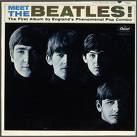
At least we had the singles, and, later on, their first album, “Meet The Beatles.” I wish I remembered my mother’s reaction to “these youngsters.” She probably didn’t like them too much. Another of “mis manías” – my obsessive habits - she probably thought.


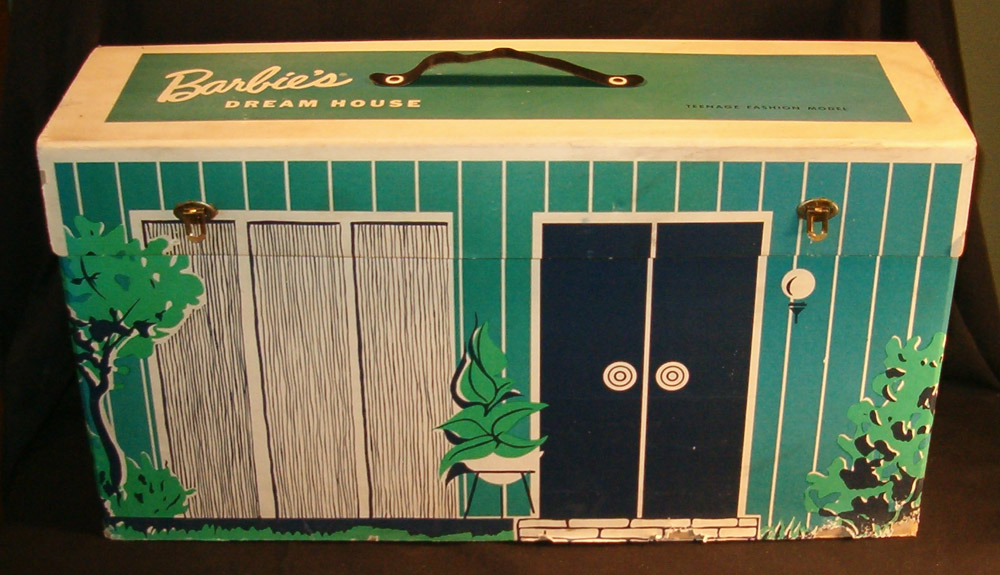
She’d already had her fill of my other one: my Barbie dolls. Though they didn’t have much money, my parents sweetly – and patiently – nurtured this other “girl” craze of mine. I lacked nothing: doll carriers; outfits; the orange sports car; the huge red bed (I’d wanted the pink canopied one, instead); the vanity; and the piano that played “I Love You Truly.”
Sometime between 1963 and 1964, they bought me the ultimate Barbie possession.
Barbie’s Dream House was made out of hard cardboard, with room dividers – and furniture – also made out of cardboard. It folded up, neatly, into an oblong “purse,” of sorts, for easy storage, and it had a handy-dandy black plastic handle. Still large and cumbersome, the house took some effort for even a chubby nine-year-old to lug around. Huffing and puffing, I managed. Proudly. Usually, though, it sat on the floor in the alcove where I used to study, right behind my desk.
And that’s where my certain thing of note number four occurred: right behind my desk. Rocking back and forth in my chair one day, I toppled backward. And squashed my Barbie Dream House almost beyond recognition.
I know I cried.
The summer of 1964 we moved to Milledgeville, Georgia. I was mainstreamed for the rest of my schooling. I remained addicted to The Beatles, and to my Barbie dolls, for several more years. My Papi eventually returned to Miami, and so did Mami and me.
But nothing would ever be the same, again.

Copyright, 2004 by Georgina Marrero 1942 words All Rights Reserved

Monday, June 16, 2008

Saturday, June 14, 2008

Nebraska Avenue--or, Always First

Ever since the late 90's--since Monicagate, to be precise--I have kept a close eye on politics. I remember watching the impassioned hearings leading up to President Clinton's impeachment: wide-eyed and wondering with whom to side all the way. Living in D.C. at the time (and attempting to find a niche on The Hill), I got in the habit of perusing both the Washington Post and the New York Times on Sundays, after having spent my mornings with Bob Schieffer; Sam Donaldson, Cokie Roberts (and, needless to say, George Will); and--first; always first--Tim Russert.

After surviving Monica and the impeachment, I found myself back in Florida. Just in time for the 2000 Presidential Election. Tim called it: "Florida. Florida. Florida." Once again, I was glued to the tube on Sunday mornings. (And almost every day at almost every conceivable hour during the "Recount" scenario--always glued to one of NBC's cable competitors, though.)

First--always first--I turned to Tim Russert.

For several years after 9/11, I confess to having gotten off the track. Until the 2004 election: once again, I tuned in. Come Sundays, first--always first--I turned to Tim Russert.

Four years later, I'm back in D.C. There's something about being here that, well, just keeps me on the ball. By the end of 2007, in heavy anticipation of the primary season, I was back to the Post and Times (online, this time); to the cable channels; and to the Sunday talk shows.

First--always first--I turned to Tim Russert. How wonderful: he appeared on MSNBC, too! (And on the nightly news, although by now it was Charlie Gibson with whom I kept company.)

Was it just less than two weeks ago that he for all intents and purposes anointed Barack Obama?

I could not believe what news awaited me when I returned home Friday night.

58 years old. I wonder, indeed, how Walter Cronkite and Mike Wallace must feel...

Eleven years ago, I spent my first few months in D.C. at The Greenbriar, a grande dame of an apartment building down Mass Ave. Northwest, I 'd told the realtor. A good neighborhood. Fine. I very quickly discovered I'd have to take a bus to get me to Dupont Circle; and that this bus had a quirky schedule. Were there any alternatives, I asked. Yes: go up a short ways beyond The Greenbriar, and turn right on Nebraska Avenue, I was informed.

So I learned to trudge up Nebraska toward Tenley Circle, often in blazing heat. On the right-hand side, I used to pass the WRC-TV's sign; and then the National Presbyterian Church. This lasted about two and a half months: by September I'd moved to the Village at McLean Gardens (now known as Vaughn Place). I knew I couldn't sustain that walk in the wintertime (and I didn't want to always have to depend on that fickle bus!).

Eleven years later I'm a little ways down Wisconsin Avenue (and am finally eating my words regarding that bus--well, sort of). I'd just returned from Georgetown when I turned on the computer.

Tim Russert has passed away, at age 58. At WRC-TV headquarters on Nebraska.

I hadn't been on Nebraska on this side of Wisconsin once since I'd moved back. But today--following an eleven-year-old instinct, I got in the right-hand lane at Ward Circle and found it. Admirers had already begun to lay flowers, posters, and mementos around WRC-TV's sign. Turning right on Van Ness, I turned left, and found a spot on Veazey Terrace. Then I walked back to Nebraska in--yes--blazing enough heat--turned left, approached the makeshift growing--yet loving--tribute to a very special human being, and paid my respects.

It's weird what you never think about until you realize you should have been thinking about it.
I never thought about that turn from Mass onto Nebraska Avenue. I just did it then, and didn't give it--or who might possibly work there--much thought. Admittedly, I hadn't politically "turned on," yet. Within months, though, I knew who came first--always first--on Sunday mornings. Tim Russert.

My thoughts and prayers are with his family and his colleagues, not only at WRC-TV, but beyond.

Georgina Marrero
June 14, 2008